

THE ARGUMENT IN BRIEF
Recognising a consumer does not establish whether a brand can influence their next decision. Anil’s Dual Addressability framework connects human preference, machine selection and fulfilment to the choices media planners make.
Why media planning must connect human preference, machine selection and the ability to fulfil a purchase.
We can match the consumer. We can recognise the device. We can connect the exposure to a purchase. But can we explain why consumers chose our brand? Or why it never entered consideration?
That is where I believe the addressability conversation needs to go next.
For several years, we discussed media addressability largely through cookies, identity graphs, clean rooms and first-party data. Important work. Much of it remains important. Yet a recognised consumer can still be expensive to reach. A reached consumer can still ignore the message. A persuaded shopper can still find the product out of stock.
Now an AI assistant may stand between the intention and the purchase. It can retrieve the wrong information, exclude a suitable product or recommend an alternative before the consumer sees a shortlist.
Knowing who the buyer is does not establish whether we can influence their next decision.
That is a more demanding definition of addressability. It also changes what we should expect from a media plan.
The cookie survived. The commercial problem remained.
Google said in April 2025 that it would retain Chrome's existing approach to third-party cookie choice. In October 2025, it announced the retirement of several Privacy Sandbox technologies.[1][2]
Those decisions changed the technical roadmap. They did not connect every platform, reconcile every identity or make every relevant buyer reachable at a sensible cost. More importantly, they did not solve a problem we sometimes hide behind impressive coverage numbers: coverage of what? A global identity footprint, a CRM match rate and campaign reach have different denominators. None should quietly become a promise of incremental growth.
The question for a CMO is more specific: Of the demand we could realistically compete for, how much can this plan influence, fulfil and evaluate credibly?I would like every major media plan to include an Addressability Loss Statement. Show where the opportunity becomes constrained: permission, activation, delivery, communication, product eligibility, availability or checkout.
Some opportunities will be unobserved. Keep them visible as unknown. An inability to track an individual does not establish an inability to influence them.
The next planning variable: how much choice is still open?
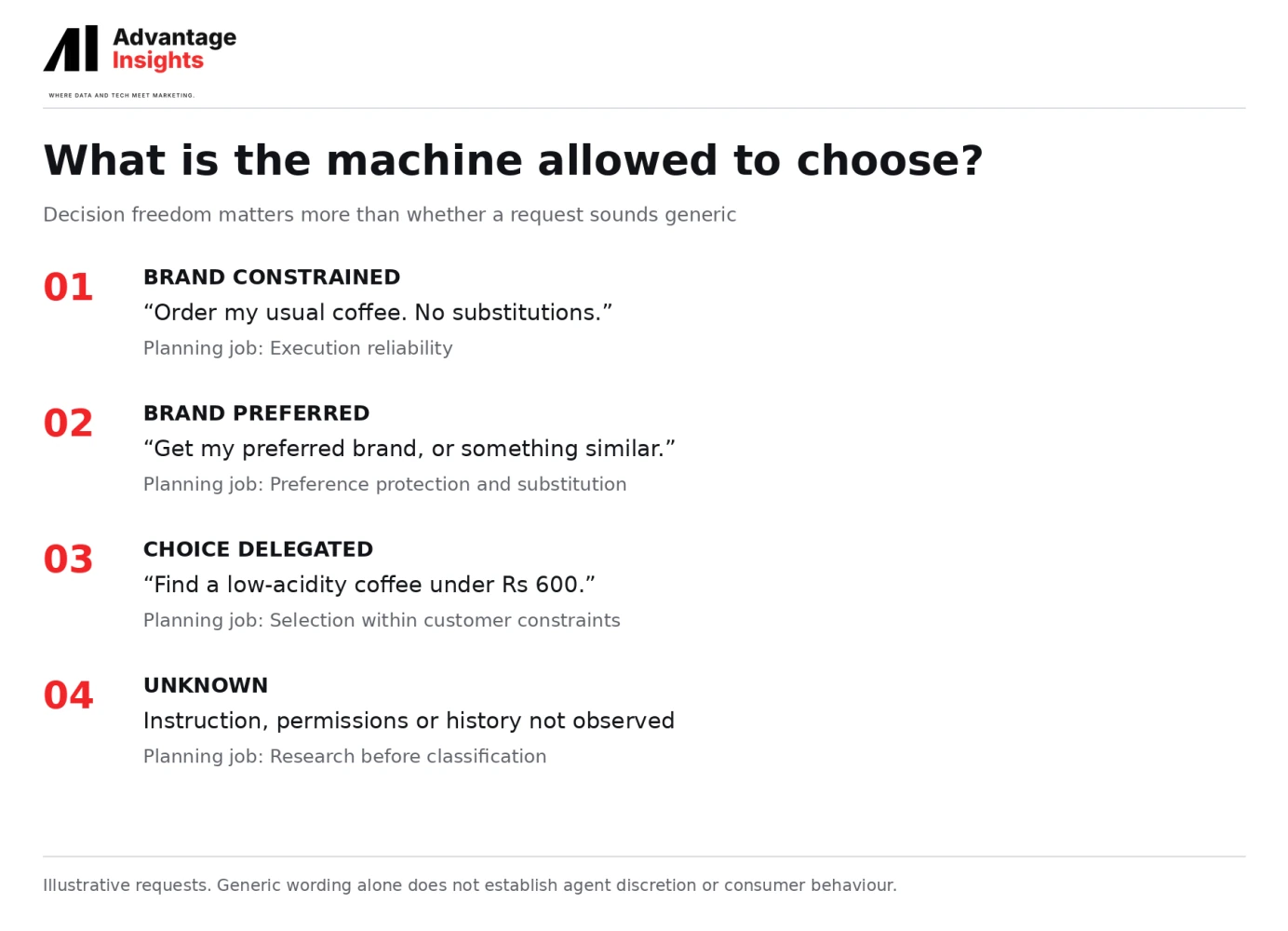
Consider three requests an assistant might receive:
- "Order my usual coffee. No substitutions."
- "Get Blue Tokai, or something similar if unavailable."
- "Find a low-acidity coffee under Rs 600."
These are illustrative requests, not observations from a platform or a brand campaign.
In the first, the immediate challenge is execution. In the second, the preferred brand has a position to protect and a competitor has a substitution opportunity. In the third, brand selection is substantially open, although price, suitability and other instructions still constrain it.
The planner needs to understand decision freedom: what is the intermediary actually allowed to choose? A generic phrase is not proof of complete discretion. "Restock coffee" may refer to a saved favourite. A named brand is not proof that advertising created the preference. It may reflect habit, experience, availability or a recommendation from a friend.I would classify decision states as brand constrained, brand preferred, choice delegated and unknown. Crucially, classify only what the evidence supports.
Search-term reports can describe the searches they contain. Social listening can describe public conversation. Neither gives us a census of private AI prompts.
Brand media may shape the instruction before the machine receives it
There is a tempting argument that a shopping agent does not respond to emotion, so emotional advertising becomes less useful. It misses the person giving the instruction.
A consumer may see a CTV campaign, develop a preference and later ask an assistant to buy that brand. Advertising may also establish a requirement: fragrance-free, a particular format, a trusted certification or a familiar use occasion.
The machine subsequently evaluates the requirement. Human communication has influenced the criteria for machine selection. This is a useful bridge between brand and performance. It does not mean every brand campaign must teach people how to write a prompt. Brands still create memory, meaning, reassurance and social value, including in purchases completed without an assistant.
Nor does it mean machine addressability belongs entirely to the performance team. A product repeatedly misrepresented by an assistant has a brand problem. A preferred product repeatedly substituted because availability information is wrong has a commercial problem.
Human influence and machine eligibility have to be planned together.In India, the dark store belongs in the addressability discussion
Imagine a premium cold-brew brand launching in Noida.
The audience is right. The video works. The shopper opens a quick-commerce app. The promoted pack is unavailable at that location. The media plan found the person. The business could not fulfil that purchase.
Introduce an assistant instructed to buy within a price and delivery constraint. An unavailable product may be excluded before the person sees it.
For an immediate purchase mission, availability becomes a condition of eligibility. That is why commerce planning needs a more practical unit: mission, location, time, available product and contribution margin.Retail media and DTC teams should ask where current inventory, assortment, delivery and return information can legitimately inform activation. Use authorised data and the controls the platform actually provides. Do not assume every retailer exposes the same signals or integrations.
For branding, retain a longer horizon. A temporary stock-out does not justify switching off all demand creation. For immediate conversion, repeatedly buying demand that cannot be fulfilled deserves scrutiny.
In physical retail, there may be no individual digital purchase trail at all. That calls for appropriate aggregate research and experiments; it does not make those buyers commercially irrelevant.
Yes, machines need an addressability framework. But they are not another audience segment.
An agent that buys media, an assistant that recommends products and a customer-authorised shopping agent do different jobs. Automating campaign execution does not automatically make a brand more likely to appear in a shopper's shortlist.
I would define machine addressability as a brand's ability to make its offering discoverable, correctly understood, eligible for consideration and actionable by a relevant machine intermediary.That extends beyond being mentioned in an AI answer. A brand can be cited and unavailable. Recommended and inaccurately described. Correctly represented and impossible to purchase through that environment.
Google's Universal Commerce Protocol describes an infrastructure for exchanging information between agents and merchant systems.[3] It does not promise a brand preferential treatment.
In India, Razorpay's February 2026 announcement described a small-user Claude pilot involving Zomato, Swiggy and Zepto, supported by UPI Reserve Pay.[4] It is a concrete example of the direction, with an important qualification: a pilot is not mainstream adoption.
We should prepare without pretending the entire market has already changed.
AI can create more opportunity and less visibility at the same time
An assistant can interpret a complex need, compare suitable products and reduce transaction friction. It can also compress the shortlist and expose limited information about why a product was selected.
A brand may become easier to buy while learning less about the decision.
That outcome depends on the platform and implementation. Agents do not universally erase tracking, nor do they provide a universal privacy guarantee. Permission to use a service should never be treated as permission to reuse every signal for advertising.
The same discipline applies to AI within advertising systems. Use it to improve product mapping, language coverage, data-quality checks and the detection of delivery constraints. Validate material product claims and recommendations. Keep observation, prediction and experimental evidence separate.
If the model is filling a gap in the evidence, label the gap. Fluency is not verification.
Dual Addressability: one commercial objective, two connected tracks
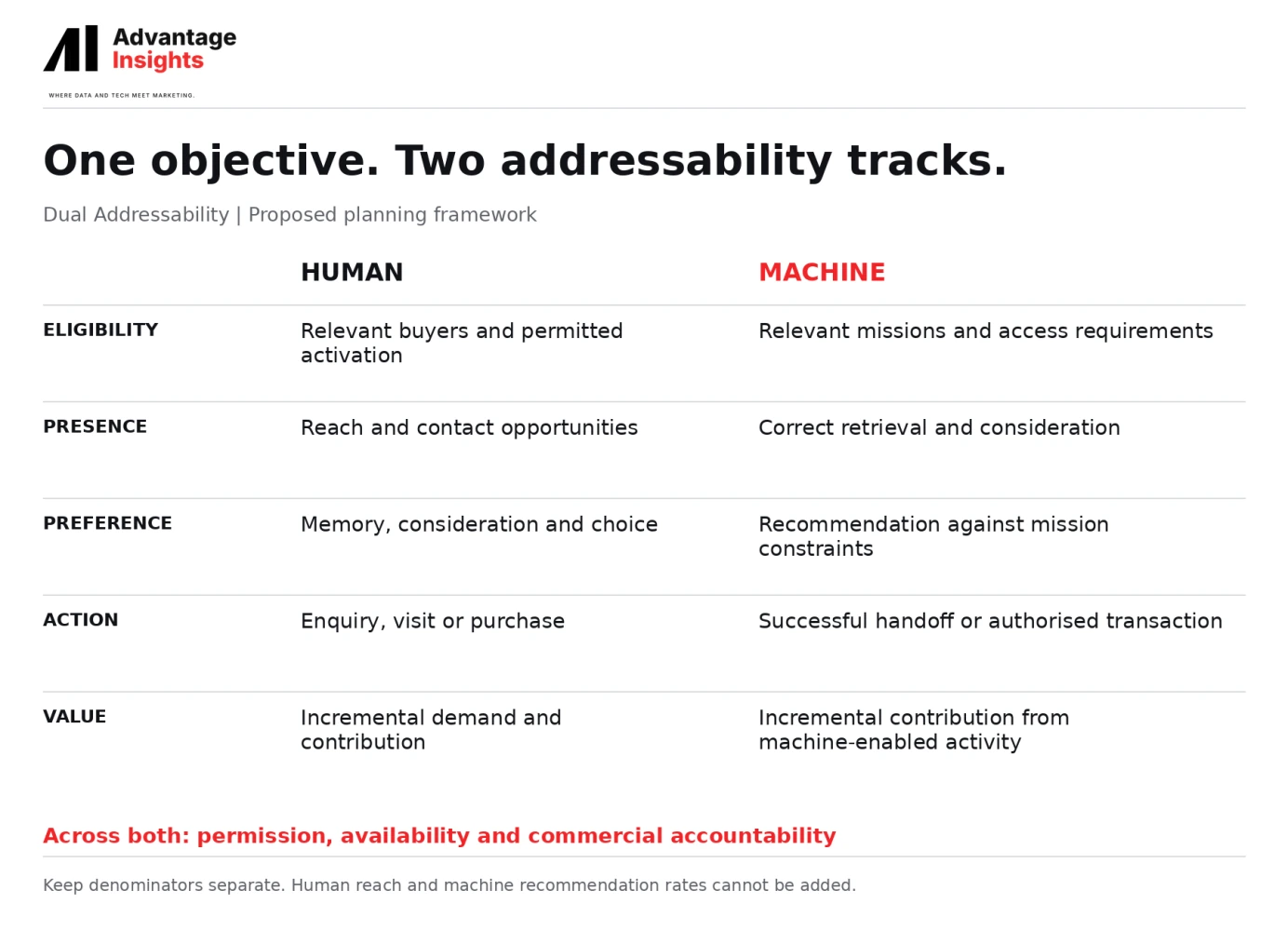
I propose Dual Addressability as a planning framework, rather than a validated industry standard.- The human track considers relevant reach, memory, preference and action.
- The machine track considers correct retrieval, eligibility, recommendation and successful execution.
- Permission, availability and commercial value run across both.
- ✅ CTV measurement must distinguish households from individual viewers.
- ✅ Social and search must distinguish reported conversions from lift.
- ✅ Retail media must distinguish retailer-attributed sales from additional brand demand.
- ✅ Machine measurement must distinguish mention, recommendation and completed action.
Do not add human reach and machine recommendation percentages together. They have different denominators.
The framework should make these differences useful to a planner, rather than compress them into one decorative score.
Who gets credit when an agent completes the order?
Execution responsibility and causal contribution are different questions.
The integration may complete the order. Customer experience may explain the repeat preference. Advertising may contribute to memory. Stock availability may prevent substitution.An order confirmation cannot resolve those contributions.
Maintain two records. The journey record contains what was observed, where legitimately available: exposure, referral, recommendation, basket, completed order, fulfilment and returns. The causal evidence record contains the research design supporting an effect claim.
Controlled advertising research has shown that observational approaches can fail to reproduce experimental effects, even with extensive controls.[9] Its findings should encourage scrutiny, rather than become a universal estimate of bias across Indian media.
A clean room improves the analysis of permitted signals. It does not supply the missing counterfactual. A named-brand instruction does not award brand media 100% of the credit. A generic instruction does not award the machine team 100% either.
The customer bought one product. We should be careful before three teams sell us the same success.
Put numbers behind the framework, without inventing precision
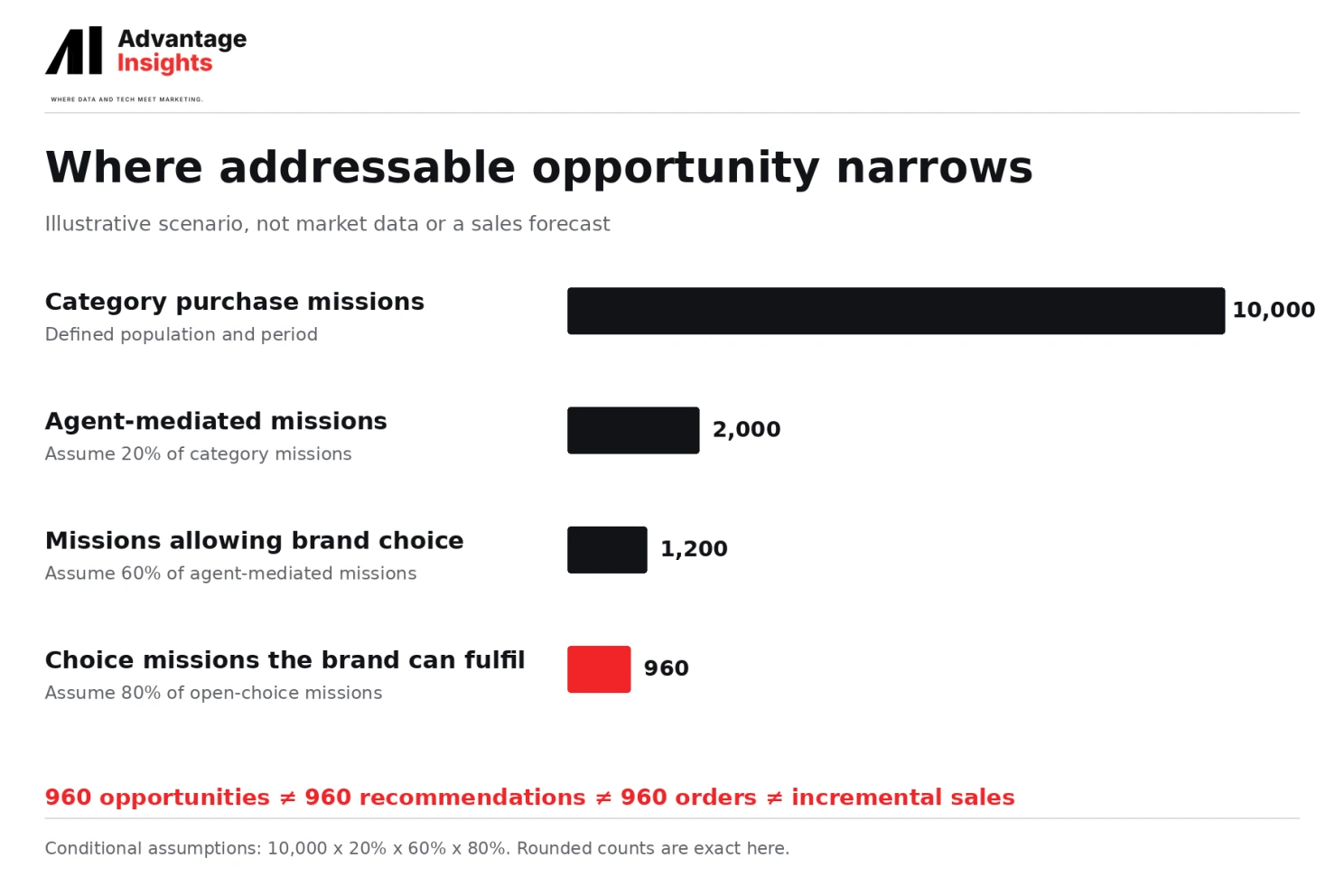
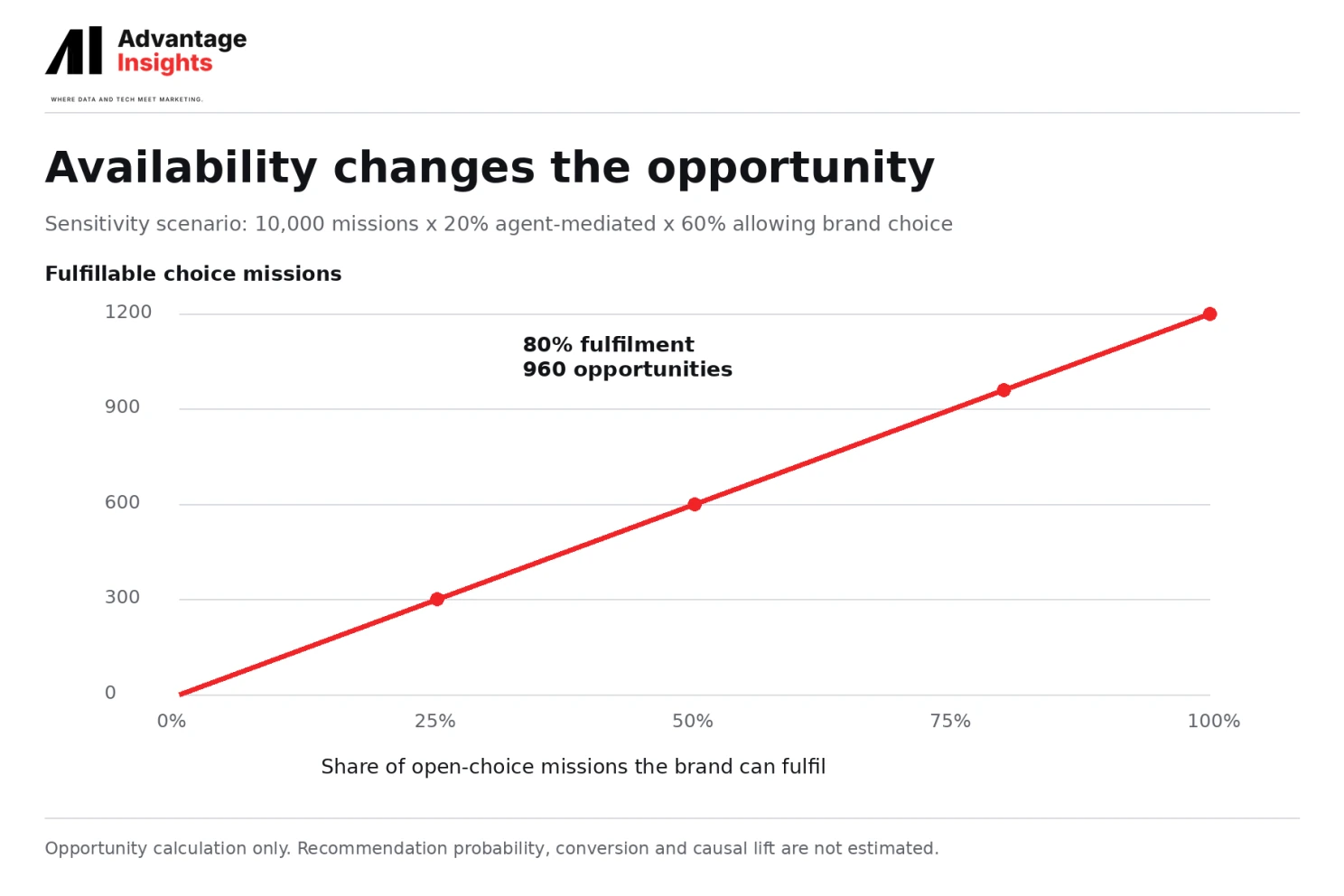
Take an explicitly illustrative scenario: 10,000 category purchase missions in a defined period. Assume 20% are agent-mediated. Within that subset, assume 60% permit brand choice. Assume the brand can fulfil 80% of those choice opportunities.
That leaves 960 fulfilable machine-choice opportunities: 10,000 x 20% x 60% x 80%.
It does not predict 960 recommendations, orders or incremental sales. It estimates an opportunity under stated, conditional assumptions.
A practical dashboard should keep those assumptions editable and expose their sources. When decision freedom is unknown, retain an unknown category or test a range. Do not silently classify the unknown as delegated.
For machine tests, report recommendations divided by eligible test runs, with the mission set, languages, locations, platforms and repeat-run variability. That describes the tests. It does not automatically describe consumer market share.
For commerce, report availability-adjusted delivery only across impressions whose inventory conditions can be assessed, and disclose that assessment coverage.
For value, compare incremental contribution before programme cost against total relevant programme cost, with the period and contribution definition stated.
What should a planner do with the next rupee?
There is no defensible universal 80:20 allocation between humans and machines.
First establish the constraint. Is it weak human reach? Incorrect product information? Missing distribution? Failed checkout? Or insufficient evidence to know?
Separate paid media, infrastructure, promotions and measurement. An API integration, an impression and a discount have different economics, even when they support the same journey.Where feasible, test changes to human media and machine readiness separately and together. Their interaction matters. Media may create demand that better infrastructure converts. Shared content and platform changes can contaminate tests, so choose the design carefully and qualify the result.
For the first 90 days, I would choose one category and a manageable set of markets. Map the missions. Audit eligibility and availability. Establish baselines. Run a credible intervention. Reallocate when the evidence supports it.
The dashboard's most useful answer may sometimes be: "We cannot justify that budget shift yet. Here is the missing evidence and the test."
That is a decision tool I would trust.
The question I would put in the next client review
The next addressability advantage will come from connecting the preference a person develops, the options a machine considers and the purchase a business can actually fulfil.
A larger identity graph can help. It cannot answer all three. Before approving the next addressability presentation, ask:
Which decisions can we influence, where do we become ineligible, and what evidence would justify our next rupee?
Anil Pandit
Subscribe on LinkedIn https://www.linkedin.com/build-relation/newsletter-follow?entityUrn=7193091017569398786
FROM THE AUTHOR’S ARCHIVE
First published by Anil Pandit on LinkedIn on 27 October 2026. Original wording and available illustrations are reproduced from that edition. Claims and references reflect the time of writing.
View on LinkedIn ↗What does this mean for your business?
Bring the question into a focused advisory conversation.
Work with Anil ↗