

THE ARGUMENT IN BRIEF
Anil examines why advertisers accept less disclosure in return for commercial benefits, then proposes a minimum accountability standard. Five rights help distinguish legitimate commercial choice from the loss of investment governance.
For my 51st edition, I’m addressing a question that has troubled me for years: how did reduced transparency become something our industry sells - and advertisers willingly buy? I believe agencies have every right to earn a fair profit. But accountability for an advertiser’s investment should never become a negotiable extra.

Commercial models can change. Accountability for advertiser investment should remain.
An advertiser is offered a better price, a delivery commitment and fewer operational headaches. In exchange, it accepts less visibility into parts of the purchase.
It signs. The campaign meets its reported targets. Everyone has a reasonably comfortable quarterly review.
What, exactly, is the problem?
That is where this conversation should begin. Declaring transparency good and opacity bad will not explain why intelligent buyers willingly choose arrangements with limited disclosure. Nor will it distinguish a legitimate commercial product from a proposition whose value cannot be adequately tested.
I believe the more consequential question is this: when an advertiser accepts less visibility, is it choosing a different commercial model, or changing its ability to govern the investment?
“Transparency cannot be a premium feature in an industry that sells accountability.”That line needs a qualification. Transparency should not require every supplier margin to be revealed. It should provide enough evidence to establish what was bought, whose interests influenced the decision, and whether the promised value can withstand scrutiny.
Why a sophisticated buyer might say yes
Principal buying deserves a fair hearing. An intermediary purchases or controls inventory and resells a defined proposition at an agreed price. It may carry commitments, aggregate demand, curate supply, add technology or accept delivery risk. Those activities can create value. They deserve compensation.
The buyer may gain price certainty, access, simpler execution or meaningful remedies if delivery falls short. A CMO purchasing a well-specified product need not automatically demand the seller's acquisition cost. We do not resolve the value of a purchase simply by discovering the seller's margin.
ISBA's February 2026 guidance explicitly recognises benefits such as pricing, agility and access, alongside the need for granular information and contractual oversight.
There is also an uncomfortable remuneration conversation. Agencies cannot indefinitely fund sophisticated talent, technology and commercial risk through fees negotiated as though expertise were interchangeable labour. Advertisers should examine the incentives their procurement choices create. That does not excuse undisclosed conflicts; it makes honest commercial design more necessary.
A conventional agent arrangement can also produce weak advice, poor controls or inadequate measurement. Principal buying and opacity are not synonyms. An open-book invoice is not a certificate of good judgment.
Where the conflict begins
The difficulty emerges when the seller also advises the advertiser on what to buy, then supplies much of the evidence used to judge the recommendation.
Imagine two eligible supply options. One offers greater expected advertiser value; the other produces more margin for the intermediary while still meeting a contractual target. This is a hypothetical incentive tension, not an allegation about how any particular business behaves.
What governs the choice? Who reviews exceptions? Can the advertiser investigate a material divergence between its interests and the seller's?
The seller should be able to defend its recommendation without necessarily disclosing every sensitive supplier agreement. The advertiser should be able to challenge it without being told that selecting the product also meant surrendering oversight.
A distributor's right to profit is legitimate. So is the buyer's right to establish what the product delivered. Both rights can coexist.
The evidence calls for better governance
ANA's March 2026 research surveyed 114 qualified client-side respondents with working knowledge of their organisations' media strategies. Fieldwork ran from October 2025 to January 2026. Fifty-seven per cent said their companies had guidelines governing principal media.
That is a finding about the respondents, not a census of advertisers or evidence of misconduct. It nevertheless raises a practical question: are approval processes keeping pace with commercial choices?
WFA's September 2026 public research summary reports that 89% of surveyed brands believed they received value for money from agencies, while 48% felt they had sufficient transparency into costing and profitability. The public page does not establish the full sampling detail, so these figures should be read as reported respondent perceptions.
They are different questions. A buyer can perceive value without understanding all the economics. That does not establish overcharging, nor does satisfaction establish that the best available alternative was chosen.
These studies should not be combined into a single industry score. Their value is in exposing decisions that deserve examination, rather than supplying ammunition against a business model.
Five rights worth separating
We use “transparency” as though it describes one thing. It can conceal several very different omissions.
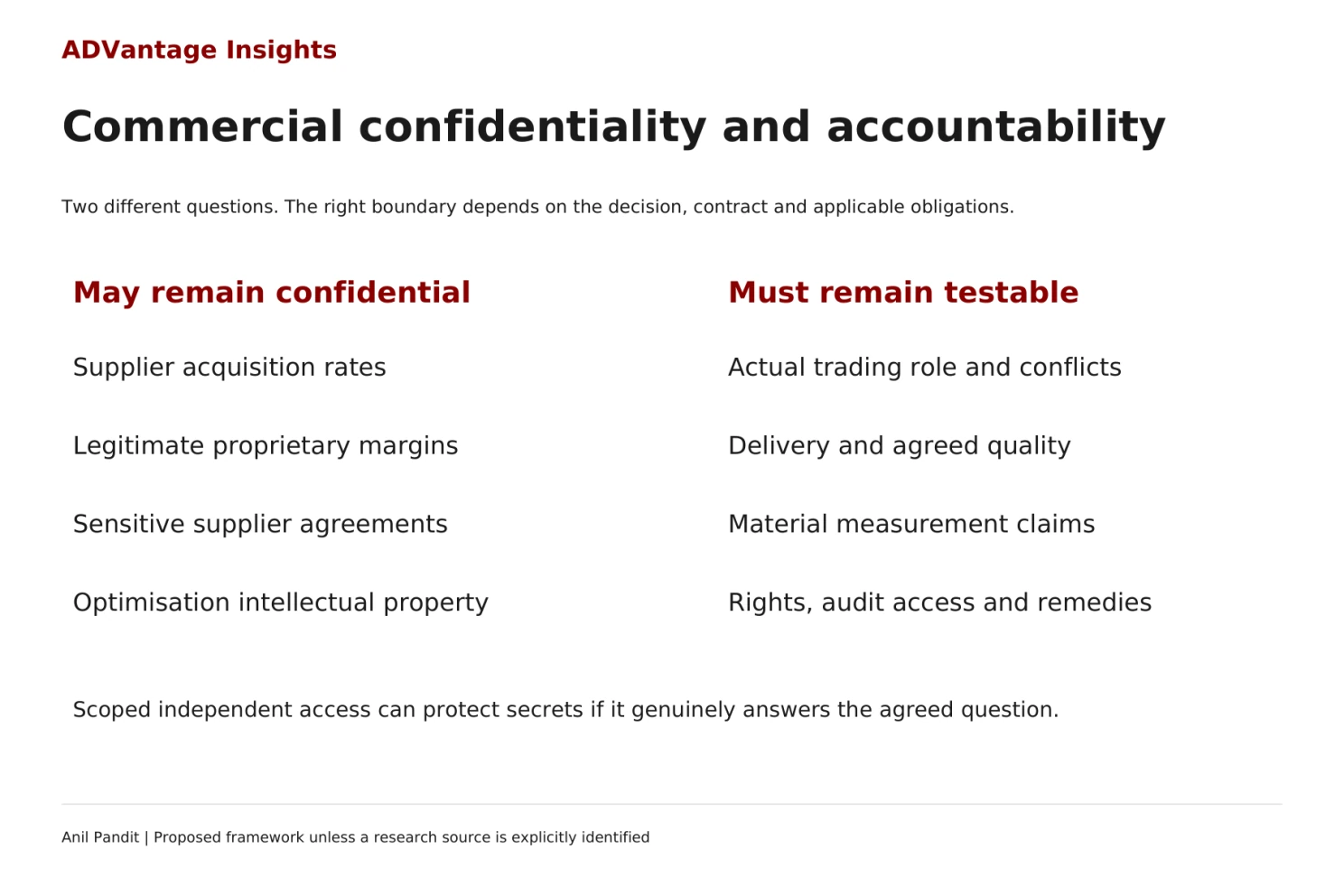
I propose the Five Rights of Marketing Transparency as a practical way to organise the discussion.
- Commercial transparency: what am I buying, in what trading relationship, at what agreed price basis, and with which material conflicts? Open-book disclosure is one possible arrangement; it is not the universal definition.
- Supply transparency: where did the advertising run, through which relevant intermediaries, and against what agreed standards? Authorised inventory and suitable inventory are different questions. A recognised seller identifier cannot establish audience value by itself.
- Decision transparency: why was a source, audience or optimisation approach favoured? The requirement is sufficient explanation of objectives, constraints and accountable authority, with records that support material decisions. It need not expose every bidding parameter.
- Measurement transparency: how was success calculated, with what denominator, coverage and limitations? Can an appropriately independent party challenge the result? Independence without adequate access is weak protection; abundant data without a credible method is no stronger.
- Data transparency: what information can the advertiser lawfully access, reuse and retain? What remains available after the relationship ends? Rights over campaign records, customer information, platform data and derived models must be specified separately.
These are proposed governance rights, not a claim that a single existing law grants identical entitlements in every market. Their purpose is to make the negotiation precise.
A lower reported cost is the beginning of the investigation
Consider two hypothetical propositions, each using a ₹10 crore budget. One offers identifiable supply and independently testable measurement. The other reports a 15% lower cost per conversion but provides less evidence about inventory composition and attribution.
The second could be the better purchase. The reported saving does not settle that question.
- Were the conversions defined consistently?
- Was the audience already likely to purchase?
- Were quality, reach and frequency comparable?
- Were returns excluded?
- What happened to incremental contribution after media and measurement costs?
The point is not that the cheaper proposition is suspect. It is that comparability must be earned.
ANA's Q1 2026 benchmark reported 54.0% of spend becoming benchmark-qualified impressions for its higher-performing cohort, versus 32.1% for the lower-performing cohort. Its release identifies 86 participating marketers and 66 active contributors, without establishing in that release the complete cohort-construction method.These are delivery-quality findings, not incremental sales returns. They do not isolate transparency as a cause. The commercial lesson is narrower: a nominal media price is an incomplete description of productive delivery.
The intelligence that can disappear after the invoice

The more durable cost may appear later.
If an advertiser cannot retain sufficiently useful records, it may struggle to compare supply options, diagnose frequency, reproduce measurement or carry learning to a new partner. That depends on the actual rights and systems involved; it is not an inevitable consequence of principal buying.
A brand can receive a successful campaign and still finish the relationship unable to explain why it worked.
- Who becomes more knowledgeable with every campaign?
- What can the advertiser's next team reproduce?
- Is the business accumulating reusable intelligence, or repeatedly renting an explanation?
Portability does not mean taking another party's proprietary model or exporting personal data indiscriminately. It can mean agreed schemas, accessible historical reports, documented definitions, experiment results and usable decision records.The exit provisions deserve attention while the relationship is healthy. Discovering the limits of institutional memory during a partner transition is an expensive way to read a contract.
The publisher belongs in this conversation
Advertiser oversight is only one end of the transaction. Publishers also need to understand and protect the commercial value of their inventory.
The spread between advertiser price and publisher proceeds is not automatically waste. It may fund technology, services, curation, credit or risk. A demand for the shortest possible path can itself oversimplify how value is created.
But both ends benefit when the intervening services can be evaluated. Relevant questions include reconciliation, payment terms, authorised sellers, duplication and the value of each intermediary.
IAB Tech Lab's sellers.json and SupplyChain mechanisms support entity and path visibility. They do not disclose every price or establish that every impression was effective. Technical observability and commercial permission to inspect records have to work together.
For publishers, agencies, DSPs and SSPs, the constructive challenge is to make verification operationally feasible while protecting legitimate confidentiality. Asking for accountability without agreeing data definitions and permissions is unlikely to produce much of it.
Commerce and television make the questions harder
Retail media brings advertising close to transactions. It can also place media sales, retail operations and measurement inside the same business. That combination creates useful capabilities and a need for explicit validation.
For a quick-commerce campaign, stock availability, promotions, distribution, delivery coverage and customer propensity may affect the result. A platform-attributed order cannot, on its own, tell us what would have happened without the advertising.
IAB and IAB Europe's November 2025 commerce-media guidance addresses counterfactuals and the choice of incrementality methods.The appropriate test depends on the decision, available data and feasible design. Every campaign need not run a large experiment; every claim of incremental impact needs a defensible basis.
CTV presents a different set of questions: publisher composition, content suitability, device environment, frequency and the extent of independent measurement. Where verification is technically limited, specify what remains observable and how the residual risk is governed. An unmeasurable impression should not casually be labelled fraudulent, or treated as fully verified.
Data providers face a related obligation: explain provenance, permitted purpose and licence boundaries. Bundling an audience into a managed product does not answer those questions.
Machines will inherit the incentives we give them
Now give an AI system authority to recommend inventory, select routes and reallocate investment.
If the operator earns different margins across eligible options, which objective governs the system? Advertiser value, contractual delivery, operator return, or an agreed combination? What happens when they diverge?
This is a design question, not a prediction that AI will misbehave. Fast optimisation can faithfully execute an objective that the budget owner never adequately examined.
MRC's January 2026 auction standards address oversight, reporting, disclosure and audit. Its July guidance considers existing standards for AI in media measurement, including model controls and limitations. Neither should be mistaken for universal certification of autonomous media buying.
My proposed requirement is practical: retain the approved objective, spending authority, material constraints, change history, observable decisions and a functioning route to human intervention. An AI-generated explanation after the event should not substitute for records of what actually happened.When machines buy, accountability must be a property of the operating system and its governance. It cannot depend solely on someone volunteering a persuasive explanation at the review meeting.
A minimum floor and a measurable hypothesis
I propose a Minimum Accountability Standard across commercial models: disclosed trading role; informed approval; material conflict handling; verifiable delivery and quality; challengeable measurement; defined data rights; and enforceable audit, correction and exit mechanisms.
Confidentiality may be accommodated through scoped auditor access or secure reconciliation. An attestation is useful only to the extent that its evidence, scope and limitations support the question being asked. It should not be a polite substitute for testing.
Regulators' requirements remain a separate jurisdiction-specific floor. A commercial waiver should never be presented as proof of legal compliance.
The Transparency Dividend is a further hypothesis: sufficient evidence and decision rights may create incremental business value through better allocation, fewer unresolved losses and reusable learning, after their costs.
It must be tested, not assumed. Compare credible alternatives, account for implementation and verification costs, and avoid counting the same benefit twice. More disclosure could produce no economic gain in a particular arrangement. A useful framework must allow that result.
I am working on an MTAI methodology that assesses controls and evidence. It does not certify ethics or predict ROI. Its weights are provisional, missing evidence remains visible, and critical failures cannot be averaged away.
The decision before the signature
Before approving a proposition, marketing, finance and procurement should establish five things: the measurable gain; the information or rights surrendered; the material economic interests; the means of testing value; and the intelligence retained on exit.
Sometimes a restricted-disclosure product will pass that test. Sometimes an apparently transparent arrangement will fail it.
Agencies have a right to build profitable products. Advertisers have a responsibility to understand the consequences of buying them. The organisation funding the investment needs enough evidence to govern it.
We can negotiate remuneration and protect legitimate commercial secrets. We should also be able to explain why our chosen arrangement deserves the budget.
When you buy media with less transparency, are you simply choosing a different commercial model - or changing who can make, verify and learn from your marketing decisions?
Anil Pandit
Association of National Advertisers WFA ISBA The Drum ExchangeWire WARC Campaign Asia-Pacific exchange4media Agencyfaqs afaqs! Adtech Today The AdAgency ADWEEK Digiday IMPACT Weekly Magazine ET BrandEquity Mumbrella LBBonline - Little Black Book Branding in Asia Mi3Australia
Subscribe on LinkedIn https://www.linkedin.com/build-relation/newsletter-follow?entityUrn=7193091017569398786
FROM THE AUTHOR’S ARCHIVE
First published by Anil Pandit on LinkedIn on 10 November 2026. Original wording and available illustrations are reproduced from that edition. Claims and references reflect the time of writing.
View on LinkedIn ↗What does this mean for your business?
Bring the question into a focused advisory conversation.
Work with Anil ↗