


THE ARGUMENT IN BRIEF
When a clean-room provider changes ownership, what happens to its promise of neutrality? Anil distinguishes independent, custodial and structural neutrality, asking how governance and architecture can protect collaboration between participants.
For years, the Data Clean Room was positioned as one of the most elegant answers to a difficult industry problem:
How do multiple parties collaborate on data without surrendering control of that data?
The pitch was powerful.
A clean room could create a protected environment for matching, measurement, enrichment and collaboration. Privacy could be preserved. Raw data would not need to be freely exchanged. Different parties could work together without directly exposing sensitive user-level information.
At the heart of that proposition sat another, often less explicit assumption:
The clean room was meant to be a neutral layer.
It stood between participants.
Not as a buyer. Not as a seller. Not as a media owner. Not as an agency interest. But as an infrastructure layer enabling trust.
That is why recent consolidation in this space deserves far more scrutiny than a standard M&A headline.
WPP acquired InfoSum. Publicis has announced the acquisition of LiveRamp.
These are rational strategic moves. Data collaboration is no longer peripheral infrastructure. It is becoming central to advertising, identity, measurement and increasingly AI-enabled decisioning.
But these acquisitions expose a deeper structural issue:
What happens when infrastructure designed to be neutral comes under ownership?That is the idea I call: Custodial Neutrality™ . By this, I don't mean good custody. I do not mean a new gold standard of neutrality.I mean the opposite.
I mean a condition in which neutrality still appears to exist — perhaps technically, perhaps operationally - but now sits inside the custody of a commercially interested owner.In simpler words: Neutrality has not disappeared. It has been taken into custody.
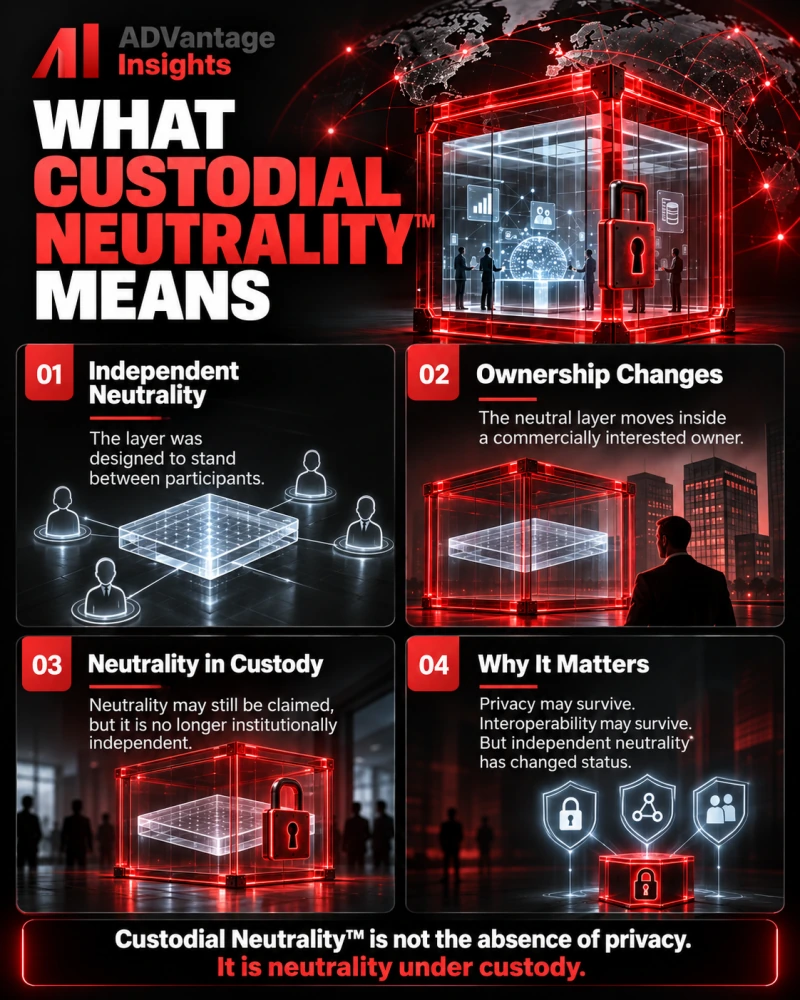
That distinction matters. Because many in our industry still think about neutrality as if it were purely a technical matter.
If the platform is privacy-safe, we assume the neutral question is solved. If the platform uses PETs, we assume the trust question is solved. If the company promises open access, we assume the independence question is solved.
But these are not the same thing.
✅ A platform can remain privacy-safe and still no longer be institutionally neutral.
✅ A platform can still offer access and still no longer be structurally independent.
✅ A platform can still work — and yet its status can change fundamentally.
That is what ownership does. The issue is not immediate bad behaviour. The issue is not that an acquirer suddenly becomes malicious.The issue is more important and more subtle:
The moment ownership changes, the status of neutrality changes.
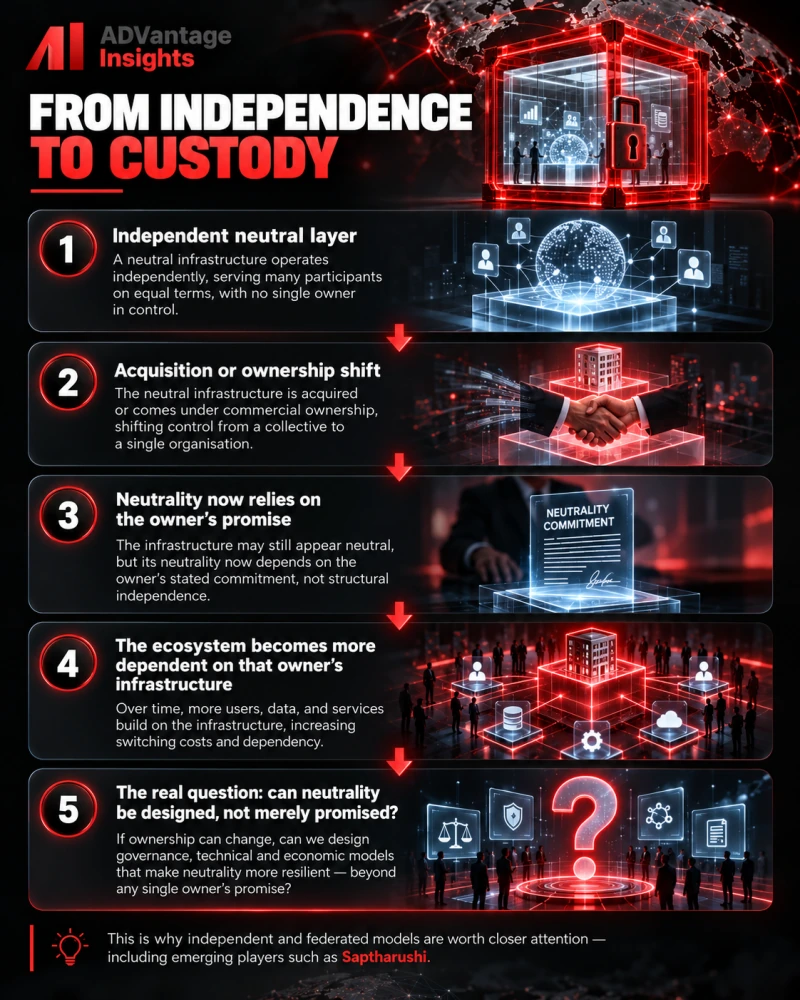
The neutral layer is no longer simply standing between participants. It now sits inside one participant’s broader commercial system. That means the industry should stop asking only:
- Is the data protected?
- Are the controls strong?
- Are the workflows privacy-compliant?
And begin asking:
- Who owns the layer now?
- What incentives surround it?
- Whose ecosystem does it now sit inside?
- What becomes easier for the owner?
- What becomes harder for everyone else?
- And can neutrality still be called independent once it is owned?
This becomes especially visible when you think from the publisher’s perspective.
🔴 A publisher increasingly deals with multiple advertisers, multiple agencies, multiple identity systems and multiple clean-room environments.
🔴 One advertiser may arrive via one DCR. Another through another DCR. Each may bring different permissions, ID logic, workflows, schemas and measurement rules.
What was meant to simplify privacy-safe collaboration can start creating another operational burden.
The publisher becomes a clean-room switchboard.

And the problem grows if some of these layers are no longer institutionally independent. Because then the question is not simply interoperability. It is gravitational interoperability.
Yes, others may be allowed in. Yes, the system may still be open. But does the owner’s position make certain integrations more natural, more native, more attractive, or more economically central?
That is the real structural question. And it is why Custodial Neutrality™ matters.
The concept is not an accusation. It is a lens.It does not say these acquisitions are wrong. It does not say these companies will misuse anything. It does not say privacy will collapse.
It says something more important:
Once a neutral layer comes under ownership, neutrality no longer lives in independence — it lives in someone’s custody.And custody changes how we should think.
Because “neutrality under custody” is not the same as “independent neutrality.” One is structurally free. The other is structurally contained.

That is why I think the industry should start distinguishing between at least three states:
1. Independent Neutrality
A neutral layer operates independently and stands between participants without sitting inside one interested owner’s commercial system.
2. Custodial Neutrality™
The neutral layer still exists and may still function well, but it now operates under the ownership and custody of a commercially interested ecosystem player.
3. Structural Neutrality
A stronger future-state ambition in which neutrality is protected not only by promises, but by architecture, governance, portability and reduced dependency on any one owner.
This is where newer and more independent models deserve attention.
For example, Saptharushi is interesting not because it should automatically be treated as the answer to everything, but because it pushes the industry toward a better question.
Its relevance lies in this:
Can neutrality be designed in a way that depends less on ownership?
That is the right direction of thought.
Not because every emerging player is automatically better. Not because independence alone guarantees success. But because the industry now needs to think beyond privacy and into institutional design. The most important clean-room question may no longer be:
🔴 Can data collaborate safely?
It may now be:
✅ Can neutrality remain neutral after ownership changes?
That is the challenge. And that is why I believe Custodial Neutrality™ is becoming one of the most important ideas for the next phase of the DCR conversation.
Because the future of data collaboration will not be shaped only by privacy engineering. It will also be shaped by:
- who owns the layer,
- who governs the layer,
- who benefits from the layer,
- and whether neutrality is still independent — or already in custody.
So the next time the industry celebrates privacy-safe collaboration, it should ask one more question: Is this neutral infrastructure? Or is it neutrality under custody?That distinction may define the next chapter of advertising infrastructure.
Anil Pandit
FROM THE AUTHOR’S ARCHIVE
First published by Anil Pandit on LinkedIn on 12 October 2026. Original wording and available illustrations are reproduced from that edition. Claims and references reflect the time of writing.
View on LinkedIn ↗What does this mean for your business?
Bring the question into a focused advisory conversation.
Work with Anil ↗