

THE ARGUMENT IN BRIEF
Advertising data is often bought without a clear account of where it came from, what people permitted or how fit it is for a particular use. Anil proposes data labels that make provenance, consent and quality visible before a buyer makes a decision.
What Front-of-Pack Food Warnings Teach Us About the Coming Revolution in Advertising Data Transparency
Full disclosure: This Newsletter is long. I'd apologise, but the advertising industry doesn't disclose anything - so why should I? Read it when you have time, care about where your data dollars go, or simply enjoy watching an industry get its nutrition label. This was always close to my heart.Grab coffee.You'll need it.
I. The Illusion of Clean Data
In every programmatic auction that fires across the global advertising ecosystem - roughly 650 billion per day - a transaction occurs that no one fully understands.
An audience segment is purchased.
A bid is placed.
A human being, reduced to a probabilistic cluster of behavioural signals, is served an advertisement.
The buyer believes the data is "clean."
The seller assures compliance.
The intermediary collects a fee.
But what, exactly, is inside that audience segment?
This is not a rhetorical question. It is the question that will define the next decade of advertising, just as ingredient transparency defined the last three decades of food regulation. And the answer, for most Chief Marketing Officers, most procurement teams, and most regulators, is the same uncomfortable admission:
''We don't actually know''
The advertising industry has constructed an elaborate architecture of confidence around data that deserves none.
We speak of "first-party data" as though provenance guarantees purity.
We invoke "consent" as though a buried pre-checked box constitutes informed agreement.
We celebrate "deterministic matching" while ignoring that the original identifier was harvested through means the consumer never understood.
The entire edifice rests on a foundation of assumed legitimacy - and that foundation is cracking.
What is needed is not another privacy framework. What is needed is a fundamentally new accountability architecture - one borrowed, improbably, from the supermarket aisle.
II. What Food Labelling Taught Us
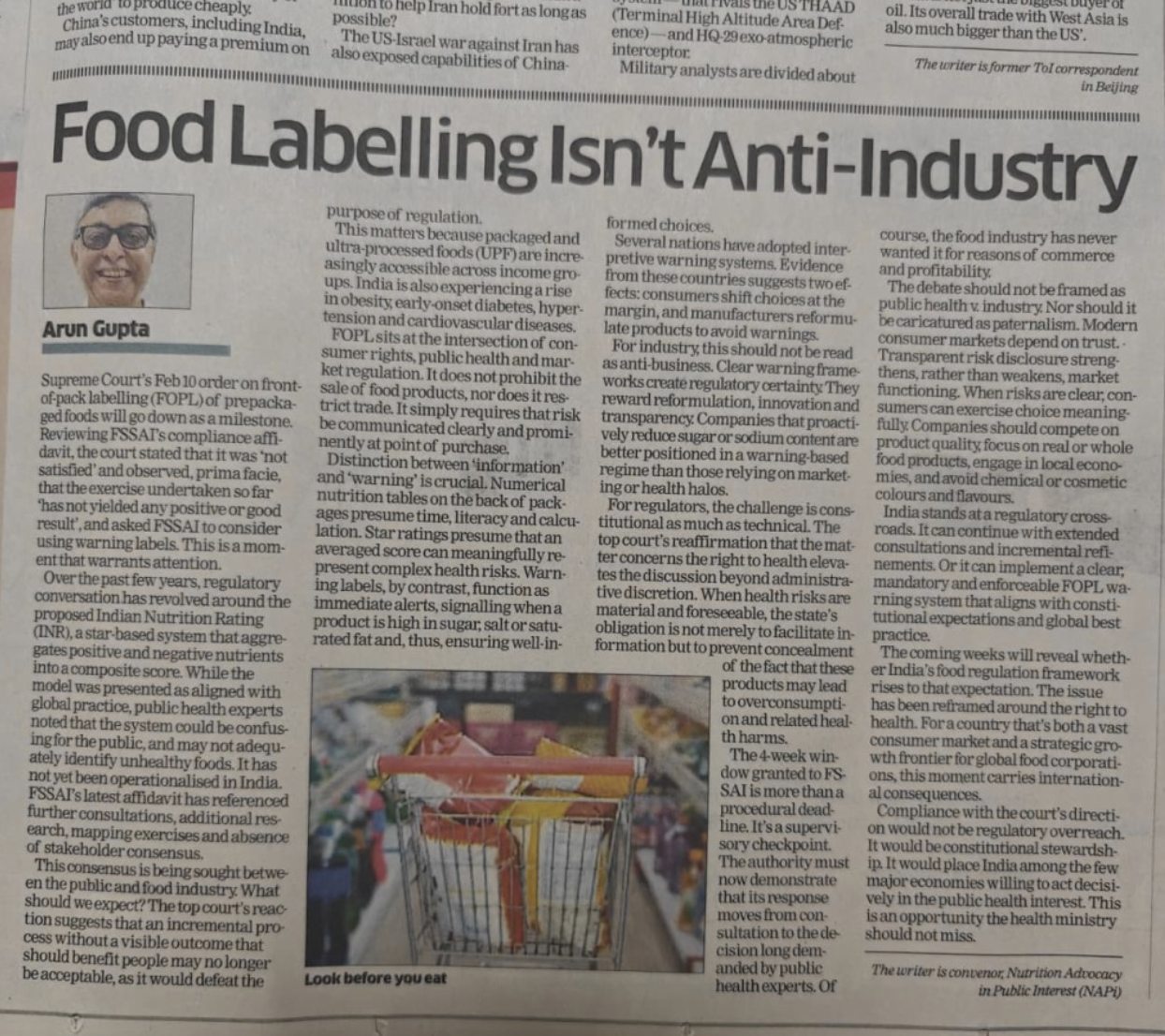
On February 10, 2026, India's Supreme Court issued a landmark observation on Front-of-Pack Labelling (FOPL) for pre-packaged foods. The court reviewed FSSAI's compliance affidavit, found the progress unsatisfactory, and directed the authority to move beyond the proposed Indian Nutrition Rating - a star-based composite system - toward clearer, interpretive warning labels.
The reasoning was deceptively simple, and profoundly relevant beyond food.
The court drew a distinction that regulators in every industry should internalise: the difference between "information" and "warning." Numerical nutrition tables on the back of packages presume literacy, time, and the capacity for calculation. Star ratings compress complex health risks into a single averaged score that obscures more than it reveals. Warning labels, by contrast, function as immediate cognitive alerts - signalling danger at the precise moment of decision.
This is not a debate about paternalism. This is a debate about the architecture of disclosure. The food industry spent decades arguing that consumers had "access" to ingredient information - buried in fine print, encoded in chemical nomenclature, distributed across regulatory filings. Access is not understanding. Information is not warning.
The court's logic carries a principle that transcends food:
''...when a product carries embedded risk that accumulates invisibly and causes harm over time, the obligation shifts from the consumer to decode complexity to the producer to disclose risk plainly.''
Replace "sugar" with "surveillance." Replace "saturated fat" with "non-consented behavioural inference." Replace "ultra-processed food" with "programmatic audience segment assembled from seventeen undisclosed data brokers." The parallel is not metaphorical. It is structural.
III. The Hidden Ingredients of Data

Every audience segment in programmatic advertising is a manufactured product. Like ultra-processed food, it is assembled from ingredients sourced across fragmented, opaque, and often untraceable supply chains. And like ultra-processed food, the final product bears no resemblance to its raw inputs.
Consider what a typical "in-market auto intender" segment actually contains.
At its origin, there may be a legitimate first-party signal - a user who visited an automotive review site.
But by the time that signal reaches a Demand-Side Platform, it has been enriched, modelled, extrapolated, and recombined.
The segment may now include probabilistic lookalikes generated from device graphs of uncertain provenance, cross-device inferences built on deterministic seeds that expired months ago, and behavioural signals harvested through SDK integrations the consumer never knowingly authorised.
I call these the Hidden Ingredients of Data, and I propose a taxonomy for categorising them:
Provenance Opacity - the inability to trace data to its original collection point and method.
Consent Decay - the degradation of consent validity over time as purposes drift and contexts change.
Inferential Contamination - the introduction of probabilistic assumptions that are treated as deterministic facts downstream.
Temporal Toxicity - the use of behavioural signals well past their relevance window, inflating segment scale while degrading accuracy.
Supply Chain Leakage - the uncontrolled replication of data across intermediaries, each adding processing layers without disclosure.
IV. The Economic Blind Spot
The financial incentives in the data supply chain are structurally misaligned with transparency. This is not a bug. It is the business model.
Data brokers profit from volume. The more segments they can create, enrich, and sell, the higher their revenue. Disclosure of ingredient quality would immediately compress margins - because it would reveal that much of what is sold as "premium data" is, in nutritional terms, empty calories. Inference dressed as observation. Modelling dressed as measurement. Recycled signals dressed as real-time intent.
For intermediaries - exchanges, SSPs, verification vendors - the incentive is throughput. Every additional data layer attached to a bid request increases the perceived value of inventory. Transparency would expose the actual signal-to-noise ratio, and in most programmatic transactions, the noise is winning.
For brands, the blind spot is structural.
This is precisely the dynamic the Indian Supreme Court identified in food. The industry argued that consumers could, in theory, decode nutritional tables. The court responded that theoretical access to information is not the same as practical ability to act on it. The same logic applies to CMOs handed a data transparency report buried in a sixty-page insertion order.
V. Why Brands Are Flying Blind
The asymmetry is stark. A brand spending fifty million dollars annually on programmatic media has less visibility into its data supply chain than a consumer reading the back of a cereal box.
Consider the layers of opacity.
The brand brief specifies an audience.
The agency translates the audience into segment taxonomy codes.
The DSP matches those codes against available inventory across exchanges.
The exchange pulls supply from publishers whose SDK integrations with data partners are governed by contracts the brand has never seen.
The data partner's methodology - how segments are built, what sources are used, how consent was obtained, how freshness is maintained - is proprietary and undisclosed.
The consequence is not abstract. Brands are making investment decisions - allocating capital, shaping customer strategies, building competitive positioning - on data foundations they cannot see, cannot verify, and cannot audit. In any other industry, this would be considered negligence. In advertising, it is called best practice.
VI. The Case for Global Data Labelling
The regulatory environment is converging toward a data labelling regime, whether the industry builds it voluntarily or not.
The European Union's Digital Services Act and AI Act already mandate transparency in algorithmic decision-making that touches consumers. The GDPR's data provenance requirements, inadequately enforced to date, establish the legal foundation for ingredient-level disclosure. California's Delete Act creates a registry of data brokers - the first step toward a supply chain map. India's Digital Personal Data Protection Act 2023 introduces consent and purpose limitation frameworks that logically extend to supply chain disclosure. Brazil's LGPD, South Korea's PIPA, and Japan's APPI each contain provisions that, when enforced rigorously, would require some version of data ingredient transparency.
The question is whether these fragmented requirements will produce coherent labelling - or whether the industry will face a patchwork of inconsistent mandates that increase compliance cost without improving clarity.
The food industry provides the precedent. FOPL systems - from Chile's black octagonal warnings to Australia's Health Star Rating to the EU's proposed Nutri-Score - demonstrate that labelling regimes emerge fastest when industry self-regulation fails to deliver meaningful consumer protection.
VII. A New Accountability Architecture: The DITL Framework

I propose the Data Ingredient Transparency Label - DITL - as a new global standard for advertising data products. Modelled on FOPL for food, DITL would require every audience segment, data product, or enrichment layer sold or used in programmatic advertising to carry a standardised disclosure
The framework rests on five pillars:
Pillar 1: Provenance Disclosure - every data element must trace back to its original collection method, source, and jurisdiction. The label must state whether the data is observed, inferred, modelled, or purchased, using standardised terminology.
Pillar 2: Consent Integrity Rating - a standardised score (A through F) measuring the quality of consent at collection, including whether dark patterns were employed, whether consent was granular or bundled, and whether re-consent has been obtained within the regulatory window.
Pillar 3: Freshness and Decay Index - a mandatory timestamp showing data age, combined with a decay rating indicating the statistical degradation of signal accuracy over time. Segments older than ninety days without re-validation would carry a "Stale Data" warning equivalent to an expiration date.
Pillar 4: Inferential Transparency - a mandatory disclosure of all probabilistic modelling applied to the data, including lookalike expansion ratios, cross-device graph confidence levels, and the percentage of the segment that is observed versus inferred.
Pillar 5: Supply Chain Map - a simplified visual showing every entity that has processed, enriched, or resold the data between collection and activation, analogous to a food product's ingredient source disclosure.
The scoring methodology would produce a composite DITL Score - ranging from DITL-A (fully transparent, consented, fresh, and first-party) to DITL-F (opaque, non-consented, stale, and heavily inferred). The score would be mandatory in bid requests, displayed in DSP interfaces, and included in campaign reporting.
VIII. Strategic Imperative for Boards
For corporate boards, DITL is not a compliance exercise. It is a fiduciary imperative.
The convergence of privacy regulation, AI governance mandates, and ESG disclosure requirements means that data supply chain risk is migrating from the marketing department to the boardroom. A company that cannot demonstrate the provenance and consent integrity of the data it uses for consumer targeting faces regulatory exposure under the GDPR, the AI Act, the DPDPA, and their proliferating equivalents.
The strategic question for boards is no longer "Are we compliant?" It is "Do we know what we're buying?" And if the answer is no - as it is for most organisations - then the follow-up question is whether the board has discharged its duty of oversight.
Forward-looking organisations should consider three immediate actions:
commission a data supply chain audit that maps every data source, intermediary, and processing layer in their advertising operations.
establish a Data Ingredient Policy that sets minimum DITL thresholds for data procurement - just as food companies set ingredient standards for their supply chains.
engage with industry bodies to advocate for standardised DITL disclosure, recognising that first-movers in transparency capture the trust premium.
IX. Regulatory Future: From Disclosure to Enforcement
The trajectory is clear. Food labelling evolved from voluntary disclosure to mandatory standards to enforcement with penalties. Data labelling will follow the same arc - and the timeline is compressing.
Regulators in the EU are already signalling that adtech's "legitimate interest" defences for data processing are unsustainable. The IAB Europe's Transparency and Consent Framework was found to violate the GDPR - a structural ruling that calls into question the legal basis for much of European programmatic advertising. In India, FSSAI's four-week deadline to implement FOPL recommendations mirrors the speed at which the DPDPA's consent framework will operationalise.
The geopolitical dimension adds urgency. Data sovereignty regimes in India, the EU, Brazil, and across ASEAN mean that audience data assembled across jurisdictions faces a patchwork of consent, purpose limitation, and transfer requirements. A global DITL standard would provide the common language that regulators, brands, and intermediaries currently lack.
The enforcement mechanism should mirror food regulation: independent auditing by accredited bodies, public disclosure of DITL scores for data products, regulatory penalties for non-disclosure or material misrepresentation, and consumer access to DITL information at the point of data collection. The infrastructure for this exists. The political will is forming. The only missing piece is industry leadership.
X. Final Vision: The Label That Changes Everything
The Indian Supreme Court's observation on food labelling was not a ruling about food. It was an articulation of a principle:
The advertising industry consumes data at a scale that dwarfs the food supply chain. 650 billion programmatic auctions per day. Trillions of data points processed annually. Billions of consumer profiles assembled, enriched, traded, and activated without a single ingredient label.
DITL is not a utopian proposal. It is an inevitability. The question is whether the industry will build it - earning trust, reducing waste, and creating competitive advantage - or whether regulators will impose it, as they have with food, pharmaceuticals, and financial products before.

The food industry fought labelling for decades. It argued that disclosure would be anti-business, that consumers wouldn't understand labels, that self-regulation was sufficient. It lost every argument. And the industry that emerged from mandatory labelling was not weakened - it was rationalised. Companies that competed on product quality thrived. Those that depended on consumer ignorance did not.
The same reckoning is coming for data.
The brands that label first will lead. The platforms that disclose first will earn trust.
The intermediaries that resist transparency will find themselves on the wrong side of history - and regulation.
Look before you bid. The era of unlabelled data is ending.
Authored By
Anil Pandit
*Disclaimer: This post is for informational purposes only and does not endorse or disapprove of any specific tools, platforms, or technologies. The views and opinions expressed in this article are those of the author and do not reflect the official policy or position of the company where he is employed.
FROM THE AUTHOR’S ARCHIVE
Original text from Anil Pandit’s article export. Claims and references reflect the time of writing.
View on LinkedIn ↗What does this mean for your business?
Bring the question into a focused advisory conversation.
Work with Anil ↗