

THE ARGUMENT IN BRIEF
Viewability and attention each answer part of the advertising question. Anil argues for examining focus and cognitive engagement before treating exposure metrics as evidence of impact.

The marketing industry has always sought better ways to measure campaign effectiveness:
First, we counted impressions
Then we demanded viewability
Now we celebrate attention
But what if we're still missing the mark?
Each step has sought to bring advertisers closer to measuring true consumer engagement. However, as the buzz around "attention metrics" grows, it’s time to ask: Is attention enough? Does simply capturing attention equate to meaningful outcomes? Or is there a deeper, more transformative metric that marketers must embrace?
As per Byron Sharp Sharp -“Attention scores for advertisements do not appear to predict advertising effectiveness. Paying more or optimizing creative for longer attention is unlikely to be worthwhile.”
Research by Kroger Technology & Digital Precision Marketing and the Advertising Research Foundation—which have no stake in the measurement business—have found little or no correlation between attention measures and sales lift or other marketer objectives.
The ARF found almost no correlation between attention measures and brand success criteria. The highest correlation—0.12 on a scale where 0 is no correlation and 1 is complete correlation—came for firms using a combination of eye tracking and facial coding. The lowest correlation, 0.003, came for companies using only facial coding, with other methods scoring somewhere in between.
Ads must attract some attention at minimum for them to have any impact, but other factors, including creative quality, pricing, messaging, and media placement, may play bigger roles in driving the outcomes marketers want.
I propose that the industry’s next frontier should not be ‘’attention’’ but ‘’focus’’. While attention is about being noticed, focus drives deeper engagement, emotional connection, and action—the outcomes marketers ultimately care about.
Marketers must shift from viewing attention as a commodity to seeing focus as an investment. The future will favour those who create content that captures not just the eye but also the mind.
The Pitfalls of Attention-Driven Advertising

1. Fragmented Experiences: In today’s multi-screen environment, attention metrics often capture fleeting glances that fail to indicate meaningful engagement.
o Example: A consumer might scroll past an ad on Instagram without processing its message.
2. Superficial Engagement: Attention metrics measure visibility but not emotional or cognitive involvement. Ads that grab attention through gimmicks may not resonate or drive action.
o Example: A flashy pop-up ad may capture attention but risks being dismissed as irrelevant or annoying.
3. Cognitive Overload: Consumers encounter thousands of ads daily, making attention a scarce resource. However, superficial attention doesn’t correlate with outcomes like purchase intent or brand loyalty.
4. Lack of Emotional Connection: Attention measures awareness, not resonance. Without focus, consumers may notice an ad but fail to connect with the brand.
Look at what Prof Byron has to say :
1. Attention Scores Are Overrated: Professor Byron Sharp argues that attention scores do not reliably predict advertising effectiveness, suggesting that the industry is overemphasizing their importance and spending too much on them.
2. Not All Advertising Requires High Attention: Sharp points out that many forms of advertising, such as print and billboards, can be processed quickly, implying that deep attention is not always necessary for effectiveness
3 . Fleeting Exposure Can Be Sufficient: Research indicates that fleeting, inattentive exposure may be more crucial than prolonged attention for brand memorability and choice, especially among familiar brands
4. Negative Impacts of Pursuing More Attention: Focusing excessively on increasing attention can limit reach, encourage ineffective creative strategies, and shift targeting towards a narrower audience of loyal buyers rather than attracting new customers
5. Mere Exposure Effects: Sharp highlights the concept of "mere exposure," where repeated exposure to a brand can enhance familiarity and preference, even if the exposures are brief
6. Skepticism Towards Attention Measurement Claims: He cautions that claims made by those selling attention metrics or high-attention media should be viewed critically, as they may exaggerate the value of attention
7. Creative Quality Over Attention: Successful advertising creativity should be prioritized over merely achieving higher attention levels; effective ads can capture attention without needing to maximize it
8. Context Matters: While attention may vary in importance depending on the product type (e.g., high-involvement products), Sharp asserts that advertisers don't need to seek more attention in every situation
Attention vs. Focus: A Paradigm Shift

As we navigate this new advertising paradigm, it becomes evident that while attention is what you see, focus is what you remember. Attention is typically understood as a passive acknowledgement of an advertisement, while focus involves a more active and intentional cognitive investment that fosters deeper processing and behavioural change.
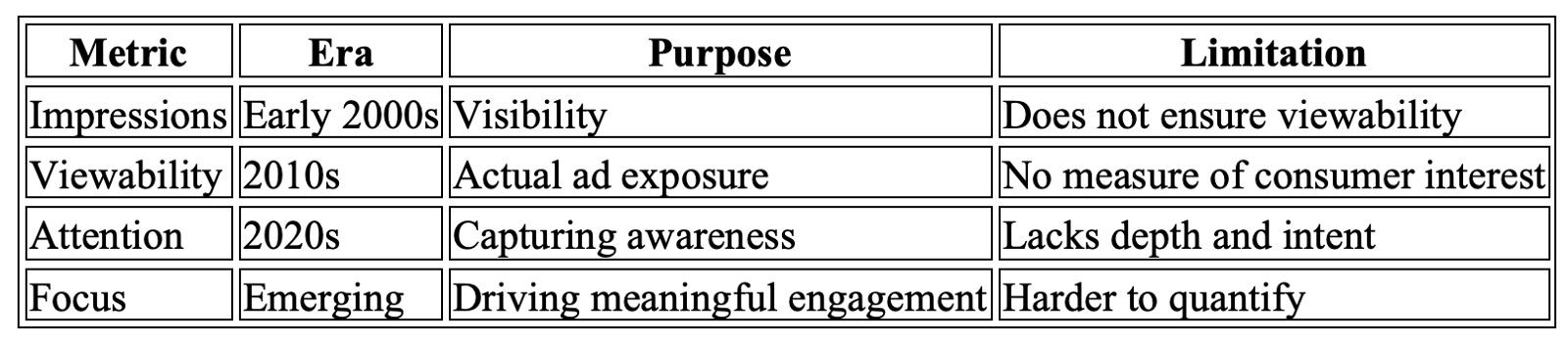
The advertising industry’s evolution reflects a growing understanding of engagement:
· Impressions: Visibility without assurance of being seen.
· Viewability: Ensuring ads are actually visible.
· Attention: Measuring awareness of an ad.
· Focus: Sustained, meaningful engagement that drives outcomes.
Critical Questions for the Industry
1. Measurement Validity
· Are we measuring what matters, or just what's easy to measure?
· How do we know if attention translates to understanding?
· Can attention metrics predict business outcomes?
2. Consumer Psychology
· What happens in the mind during attention versus focus?
· How does emotional engagement differ between the two states?
· What role does context play in transforming attention into focus?
3. Business Impact
· Does increased attention necessarily lead to increased sales?
· How does focus correlate with brand loyalty and advocacy?
· What's the ROI difference between attention and focus?
Neurological Evidence: Recent neuroscience research shows that focus, not mere attention, is required for information to transfer from short-term to long-term memory. This has profound implications for brand building and consumer behaviour.
Behavioural Economics Perspective: According to behavioural economics, consumers make decisions based on what's top of mind and easily recalled – not just what they've been exposed to. This suggests that creating focused engagement is more valuable than capturing fleeting attention.
Attention vs. Focus: A Foundational Difference
Attention
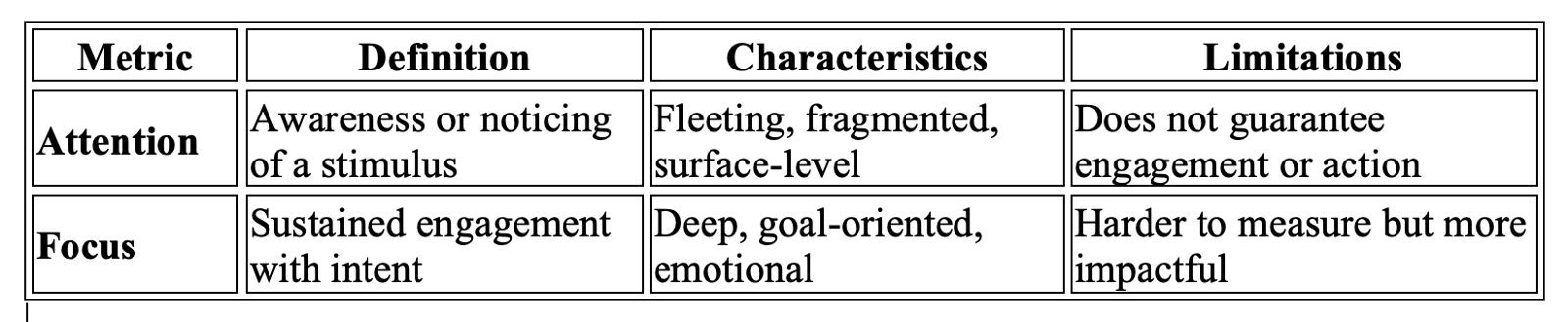
· Definition: Attention refers to the act of noticing or being aware of a stimulus. It’s often fleeting and easily fragmented.
· Characteristics:
o Passive: Attention can be captured without effort, such as glancing at a banner ad.
o Superficial: Attention doesn’t guarantee comprehension or emotional engagement.
o Short-lived: A momentary pause that may not translate into action.
· Metrics: Tools like Lumen and Adelaide measure dwell time, eye-tracking, and viewport visibility to quantify attention.
Focus
· Definition: Focus involves sustained and deliberate cognitive engagement with a task, message, or idea. It requires active participation and emotional resonance.
· Characteristics:
o Active: Consumers actively process the message, integrating it with their needs.
o Deep: Focus supports memory retention and decision-making.
o Goal-oriented: It aligns with achieving specific outcomes, such as purchase intent.
· Psychological Basis: Mihaly Csikszentmihalyi’s concept of "flow" highlights focus as a state of immersive engagement where distractions fade away.
The Case for Focus
Why Focus Matters
Focus is the antidote to fragmented, superficial engagement. Here’s why it’s essential:
1. Deeper Engagement: Focused consumers process ads at a cognitive level, leading to stronger brand recall and better decision-making.
o Insight: Ads that foster focus increase comprehension and memory encoding, driving outcomes.
2. Emotional Resonance: Focus builds emotional connections, fostering trust and loyalty.
o Statistic: Nielsen studies show emotionally engaging ads deliver 23% higher brand recall.
3. Clarity and Relevance: Focus allows brands to cut through clutter by delivering targeted, meaningful messages.
4. Outcome-Driven: Focus is directly correlated with actionable behaviours such as website visits, purchases, and advocacy.
Example: A campaign that engages focused users may achieve higher conversion rates than one that optimizes for mere attention.
How to Enhance Focus in Advertising

To prioritize focus, marketers must rethink strategies and creative execution. Here’s how:
1. Leverage Emotional Storytelling
Narratives evoke empathy and sustain engagement. Ads with compelling stories build stronger connections.
o Example: Nike’s "Just Do It" campaign inspires focus by appealing to core human values like perseverance.
2. Personalize Experiences
Use first-party data to tailor messages that align with individual preferences and behaviours.
o Example: Dynamic creatives that adapt messaging based on browsing history.
3. Simplify Messaging
Avoid overwhelming consumers. Deliver clear, concise, and actionable content.
o Insight: Overly complex ads dilute focus and reduce comprehension.
4. Optimize Context
Place ads in environments that encourage sustained attention, such as OTT platforms, podcasts, or curated content feeds.
5. Incorporate Interactive Elements
Gamified experiences, quizzes, or AR/VR elements sustain engagement by requiring active participation
How to Measure Focus
Focus requires sophisticated tools that go beyond traditional metrics. Here are approaches to consider:
1. Cognitive Engagement Metrics
Use technologies like EEG and fMRI to track brain activity, revealing depth of engagement.
2. Behavioural Indicators
Monitor actions like time spent on a product page, clicks on interactive elements, and navigation patterns.
3. Emotional Resonance Surveys
Measure how well an ad aligns with consumer emotions and values using sentiment analysis tools.
4. Focus Time Analysis
Track time spent actively engaging with content, factoring out distractions.
5. Attention-to-Focus Ratio
Calculate the proportion of users transitioning from attention to sustained engagement.
The Future of Advertising Metrics
Attention metrics marked progress, but they’re not the final destination. In a world inundated with distractions, focus offers a way forward— one that prioritizes depth, relevance, and action. By embracing focus, brands can create campaigns that resonate, influence, and deliver measurable outcomes.
What do you think? Is it time to move beyond attention and embrace focus?
Anil Pandit
Executive Vice President
Publicis Media, India
*Disclaimer: This post is for informational purposes only and does not endorse or disapprove of any specific tools, platforms, or technologies. The views and opinions expressed in this article are those of the author and do not reflect the official policy or position of the company he is employed in.
References:
FROM THE AUTHOR’S ARCHIVE
Original text from Anil Pandit’s article export. Claims and references reflect the time of writing.
Some original illustrations could not be recovered from the export’s image links.
View on LinkedIn ↗What does this mean for your business?
Bring the question into a focused advisory conversation.
Work with Anil ↗